Opening hook
Ever stared at a map and wondered how far you’d actually travel if you added a kilometer, a couple of meters, and a handful of centimeters together? On the flip side, it sounds like a simple math problem, but the real challenge is keeping the units straight while you’re juggling them in your head. And that’s where most of us slip up.
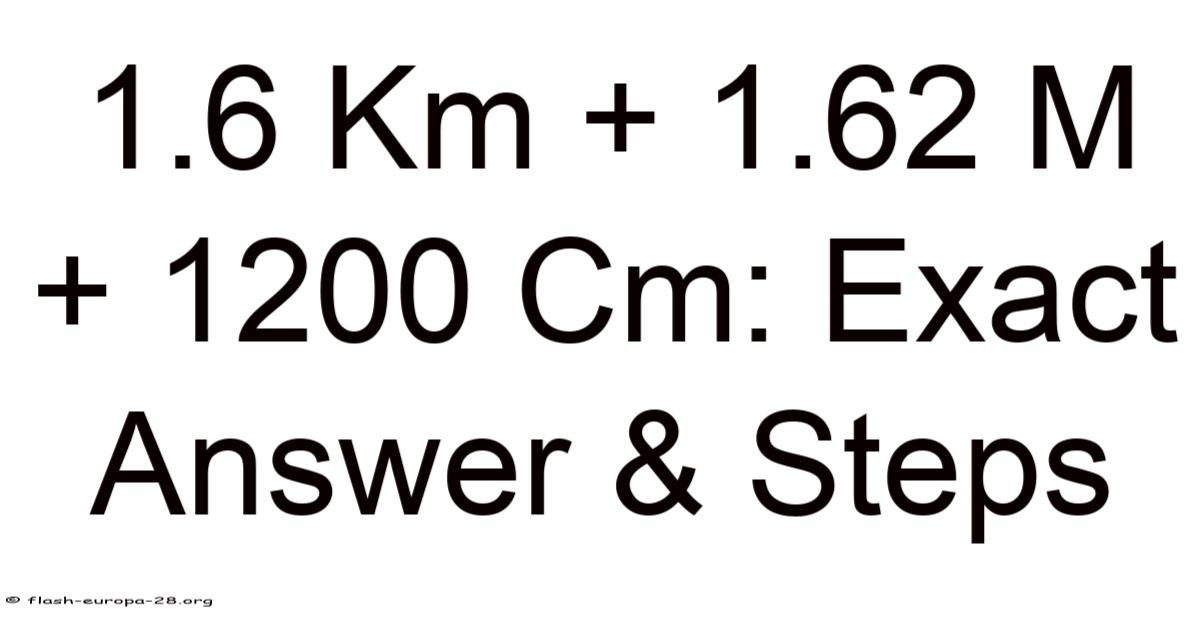
What Is 1.6 km + 1.62 m + 1200 cm
Understanding the Units
Let’s break it down. Also, when you see “1. Because of that, a kilometer (km) is a thousand meters, a meter (m) is the basic unit we use for everyday distances, and a centimeter (cm) is one‑hundredth of a meter. That's why 6 km + 1. 62 m + 1200 cm,” you’re looking at three different scales of measurement that need to be harmonized before you can add them meaningfully Worth keeping that in mind..
Converting to a Common Unit
The easiest way to add these numbers is to convert everything to meters. This leads to 62 m + 12 m. One kilometer equals 1,000 meters, so 1.So the expression simplifies to 1,600 m + 1.6 km becomes 1,600 meters. Now, 1200 centimeters — since 100 cm equals 1 meter — turns into 12 meters. Day to day, 62 meters stays as is. Because of that, the 1. 62 meters. And add those together and you get 1,613. That’s the raw total before you decide how to present it Small thing, real impact..
No fluff here — just what actually works.
Why It Matters / Why People Care
Real‑World Scenarios
Imagine you’re planning a hiking route. 6 km warm‑up run, a 1.6 km long, you’ve measured a side path that’s 1.You know the trail is 1.62 m extension could affect material orders and budgeting. Because of that, in construction, adding a 1. So if you miscalculate the total distance, you could end up underestimating how much water you need, how long the hike will take, or even miss a checkpoint. Which means in sports, a sprinter might add a 1. 6 km foundation length to a 1200 cm footing and a 1.62 m, and you’ve marked a short detour that’s 1200 cm. 62 m hurdle gap, and a 1200 cm sprint start distance — getting the sum wrong could mess with pacing.
Consequences of Getting It Wrong
When units aren’t aligned, the math can be off by orders of magnitude. Adding 1200 cm (12 m) to 1.6 km without converting could make you think you’re only a few meters away from a 1.Now, 6 km goal, when in reality you’re still over a kilometer short. That kind of error can lead to wasted time, extra cost, or even safety hazards. In practice, the smallest slip can snowball into a big problem Practical, not theoretical..
And yeah — that's actually more nuanced than it sounds.
How It Works (or How to Do It)
Step 1: Convert Everything to Meters
Start by turning each measurement into meters.
- 1.6 km → 1,600 m (multiply by 1,000)
- 1.62 m → stays 1.62 m
- 1200 cm → divide by 100 → 12 m
Now you have a uniform set of numbers.
Step 2: Add the Numbers
Add the three values:
1,600 m + 1.And 62 m = 1,601. Still, 62 m
1,601. 62 m + 12 m = 1,613.
That’s the total in meters.
Step 3: Convert Back to Desired Units
If you need the answer in kilometers, divide by 1,000: 1,
613.62 m ÷ 1,000 = 1.61362 km. Rounded sensibly, that's about 1.61 km or 1.614 km depending on the precision your project demands. If you prefer centimeters, multiply by 100: 1,613.62 m × 100 = 161,362 cm. Each format tells the same story — just at a different zoom level.
Quick Checklist
Before you finalize any answer, run through this short list:
- Identify every unit in the expression.
- Pick one base unit (meters is usually the friendliest choice).
- Convert each value using the correct factor (1,000 for km → m, 100 for cm → m).
- Add the numbers carefully, watching decimal places.
- Convert back only if the context calls for it.
Skipping even one step is where most mistakes creep in, especially when you're juggling multiple units in a single problem.
Final Thoughts
Adding measurements from different units isn't a trick question — it's a practical skill you'll use whether you're cooking, building, navigating, or just doing homework. On top of that, the key takeaway is simple: **always convert before you add. Worth adding: ** Once everything speaks the same language, the math takes care of itself. So the next time you see something like 1.6 km + 1.62 m + 1200 cm, you'll know exactly what to do — and you'll get 1,613.62 meters (or 1.61362 km) every time, no surprises.
###Real‑World Scenarios Where Unit Conversion Saves the Day
Construction and architecture – A project calls for a foundation that is 12 m long, a reinforcement bar that must be laid 1.62 m beyond the edge, and a drainage trench that extends 1200 cm from the building’s corner. If the team forgets to convert the centimetre measurement, they will order a trench that is only 12 m long instead of the required 12.12 m, leaving a 12‑centimetre gap that can compromise water flow and structural integrity.
Sports coaching – A sprint coach may prescribe a 1.6 km warm‑up run, a 1.62 m hurdle clearance, and a 1200 cm runway for the start. Misreading the runway length as 1.2 km would lead the athlete to start far too far back, disrupting rhythm and potentially causing a false start Which is the point..
Logistics and shipping – A warehouse manager needs to load pallets that together occupy 1.6 km of aisle space, an additional 1.62 m of clearance for a forklift, and a 1200 cm pallet stack. Converting everything to metres reveals that the total aisle requirement is 1.61362 km, ensuring the forklift can maneuver without scraping the walls The details matter here..
Common Pitfalls and How to Dodge Them
- Skipping the conversion step – Even a quick mental estimate can hide a factor of 100 or 1000. Always write down the conversion factor before you begin adding.
- Rounding too early – Keeping extra decimal places through the addition phase prevents cumulative error, especially when the final answer must be reported to a specific precision.
- Mixing up the direction of conversion – Remember that kilometres to metres multiply by 1 000, while centimetres to metres divide by 100. A reversed operation will inflate or shrink the result dramatically.
Handy Tools and Resources
- Online converters – Websites that let you input a value and select the desired unit instantly.
- Spreadsheet formulas – In Excel or Google Sheets, the
CONVERTfunction (e.g.,=CONVERT(A1,"km","m")) automates the process and reduces manual error. - Physical reference cards – A pocket‑size card listing the most common conversion factors (1 km = 1 000 m, 1 m = 100 cm, 1 m = 10 mm) can be a quick sanity check on the job site.
Final Takeaway
When measurements appear in disparate units, the safest habit is to bring every quantity into a single, familiar unit before performing any arithmetic. This disciplined approach eliminates the risk of order‑of‑magnitude mistakes, streamlines communication among team members, and ensures that budgets, material orders, and schedules stay on target. By mastering the simple three‑step routine — identify units, convert to a common base, then add — you’ll turn what looks like a tangled mix of numbers into a clear, reliable total, no matter the context
Advanced Applications: Beyond Simple Addition
Mastering unit conversion extends far beyond straightforward addition. In scientific research, combining data from disparate instruments often requires converting measurements to a common unit for meaningful analysis. Take this: calculating the total energy dissipated by a system might involve integrating force (Newtons) over distance (metres and centimetres), demanding precise conversion to ensure accurate integration. Similarly, in architectural drafting, converting all dimensions to millimetres before scaling ensures compatibility between structural elements and decorative details, preventing costly clashes during construction And that's really what it comes down to..
Even in culinary arts, precision matters. And 8 litres) for accurate batching and scaling, especially in commercial kitchens where consistency is essential. Plus, 5 + 0. This leads to , litres: 2 + 0. A recipe specifying 2 litres of stock, 500 millilitres of wine, and 30 centilitres of cream requires conversion to a single unit (e.g.Practically speaking, 3 = 2. Missteps here can ruin flavor profiles or yield incorrect portion sizes.
Cultivating Measurement Literacy
True proficiency involves internalizing conversion relationships. "
- Centimetres to metres: "Move the decimal point two places left.Instead of relying solely on calculators, practice estimating conversions mentally:
- Kilometres to metres: "Move the decimal point three places right."
- Metres to millimetres: "Multiply by 1,000 (or move decimal three places right).
This mental agility allows for quick sanity checks. If converting 1200 cm to metres yields 12,000 m instead of 12 m, the error is immediately obvious, prompting a review of the conversion factor.
Conclusion
The seemingly simple act of adding measurements across different units is a gateway to precision in countless professional and personal contexts. Whether constructing infrastructure, training athletes, managing logistics, conducting research, or crafting a meal, the principle remains unwavering: consistency in units is non-negotiable. Now, by systematically converting all values to a common base before calculation, practitioners eliminate a major source of error, safeguard against costly mistakes, and check that the final result accurately reflects the intended quantity. This disciplined approach transforms ambiguous figures into actionable data, fostering efficiency, reliability, and confidence. At the end of the day, mastering unit conversion is not just about arithmetic; it’s about building a foundation of accuracy that underpins success in any field where measurement matters.
